


Glimmer: Interactive Fanfics
Glimmer Fics Inc.
I spent time with Glimmer as an entertainment app built around interactive fan fiction, and my first impression was that it feels closer to reading with decisions than to playing a conventional game. The appeal is simple: instead of moving through a story passively, I get moments where my choice influences how I continue. That makes even a short reading session feel more personal, especially when I am already interested in the kind of fictional world or character-driven drama that fan fiction usually offers.
That format also explains who will enjoy it most. If you like stories but lose interest when an app asks you to do too much, Glimmer keeps the focus on reading and choosing. If you want deep game mechanics, open exploration, or a carefully balanced competitive system, this is probably not the right place to look. I see it as a relaxed, choice-based entertainment app for people who want to steer a narrative without learning a complicated set of rules.
How Glimmer fits into interactive reading
The app’s central idea is choosing your own adventure, but the experience is not identical to picking up a printed novel or opening a standard fan-fiction archive. In a normal story, I follow the author’s route from beginning to end. In Glimmer, the attraction comes from pausing at a decision and asking what might happen if I take the other path. That small change gives the reading session a more active rhythm.
I found that the best way to use it is in short, focused sessions. Rather than treating it like a game that needs a long uninterrupted evening, I can open it when I have a few quiet minutes and continue from a decision point. That makes it a practical choice for a commute, a break, or winding down before sleep, provided I am comfortable reading on a phone and staying within the app’s teen-oriented content setting.
The fan-fiction angle is important. Readers who already enjoy stories inspired by familiar fictional types, relationships, and dramatic setups will understand the appeal quickly. The interactive structure gives those themes an extra layer because I am not only asking whether I like the writing; I am also deciding how I want the protagonist’s situation to develop. That personal involvement is the main reason I kept wanting to see another branch.
Related News

Why WhatsApp Messenger Still Makes Everyday Communication Feel Easy

Jurassic World: The Game Is the Better Dino Tycoon for Strategic Players

Threads in Real Life: Who Should Join, Lurk, or Leave

How SHEIN Turned Shopping Into an Endless Content Feed

How to Make Fortnite Feel Smarter on Mobile

Should You Switch to Microsoft Outlook on Mobile?
At the same time, I would not describe this as a replacement for every kind of reading app. A conventional fiction reader is better when I want a complete, uninterrupted narrative with no decision prompts. A fan-fiction archive may be better when I want the broadest possible choice of stories or a more traditional browsing experience. Glimmer makes a narrower promise, and its value depends on whether that combination of fan fiction and interaction matches my mood.
What the free download really means
Glimmer is free to download, which makes trying the basic experience relatively easy. The important distinction is that free access does not mean every part of the experience has the same cost. The app includes in-app purchases ranging from $0.99 to $99.99 per item, so I would approach it as a free starting point rather than assuming the complete experience is entirely free.
That pricing range changes how I judge value. The free entry is useful because interactive fiction is personal: a format that sounds appealing may not hold my attention once I begin reading. I can test whether the writing style, pacing, and decision structure suit me before spending anything. If I do enjoy it, the paid side should be considered optional value for someone who wants more from the app, not an automatic reason to buy.
Gallery
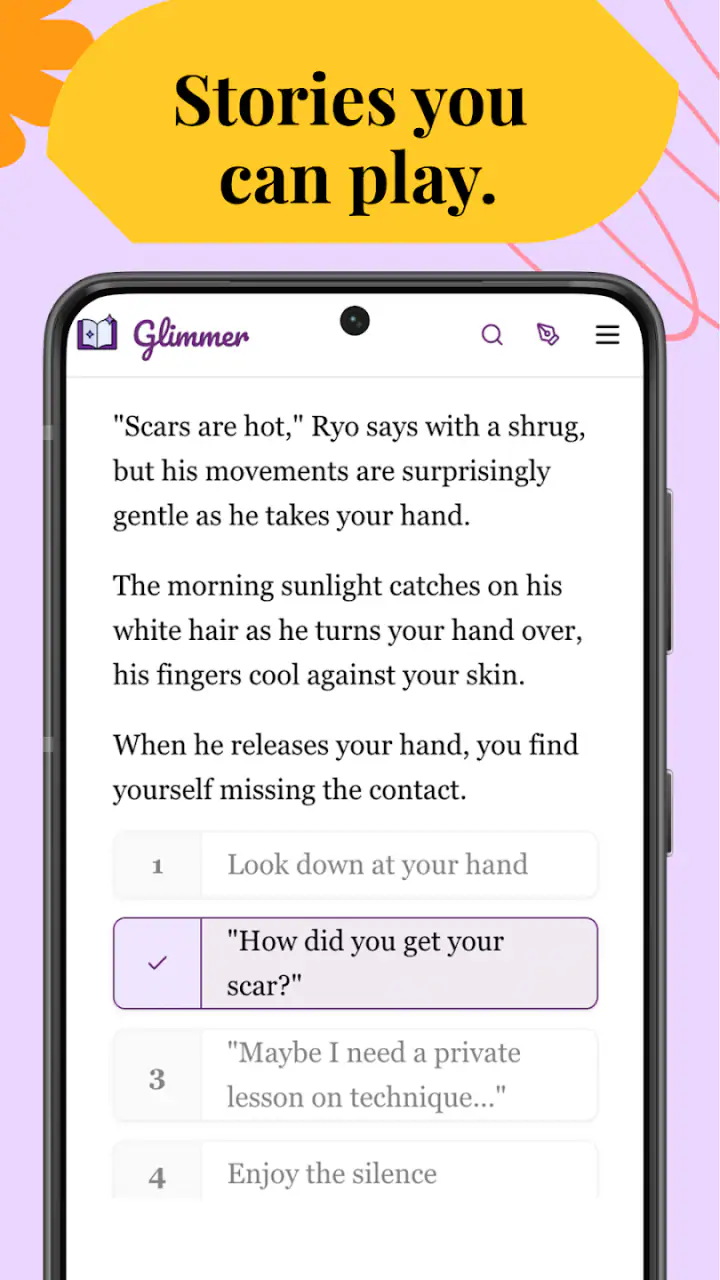
I also recommend deciding on a personal spending limit before making purchases. The low end is small enough to feel casual, while the upper end is substantial enough that repeated impulse buying could change the overall cost of using the app. I would not purchase simply because a story ends at an inconvenient moment or because I want to see every possible outcome immediately. I would first check whether I am enjoying the actual reading and choices rather than chasing completion.
This is where Glimmer differs from a one-time paid novel. With a book, I usually know the price before starting and can judge the entire work as a single purchase. With a free app that offers items inside the experience, the value decision happens gradually. That can be convenient, but it requires more attention from the reader. The right question is not only “Is it free?” but also “Am I getting enough enjoyment from the interactive format to justify any optional spending?”
Where the entertainment value comes from
The strongest part of the experience is the feeling that my reading choices matter to me, even when the interaction remains simple. A decision can make me reconsider a character, replay a section mentally, or wonder how a different response might change the mood. That is a different kind of engagement from scrolling through a regular story, where I may read quickly but rarely stop to reflect on my role.
One useful habit is to make choices based on the personality I want to explore instead of always selecting the safest answer. On a first run, I might respond as I naturally would. On a later session, I can make decisions from a different perspective and compare how the story feels. This gives the app replay value without requiring me to treat it like a high-pressure game. The trade-off is that replaying only feels worthwhile when the writing and branching decisions are strong enough to support curiosity.
Another practical use is sharing the experience with a friend without turning it into a multiplayer activity. I can describe a difficult choice, ask what they would do, and then compare the results of our reading paths. That works well for fans who enjoy discussing character decisions and imagined alternatives. It is a social conversation around the story rather than a built-in competitive feature, so it remains informal and easy to fit around everyday life.
I also found that the app works best when I treat each decision as part of the story’s tone, not as a puzzle with one correct answer. Looking for the “winning” option can make interactive fiction feel mechanical. Choosing according to the character or mood keeps the experience more like reading. This is a small change in approach, but it makes the app more enjoyable for me because I stop worrying about optimizing every branch.
The entertainment value is therefore less about technical complexity and more about involvement. Glimmer does not need to replace a console game to be worthwhile. Its purpose is to make reading feel more responsive. For a fan who wants a lightweight way to spend time inside character-focused stories, that can be enough.
The trade-offs I noticed while using it
The biggest limitation is that interactive fiction cannot remove the weaknesses of the underlying writing. Choices may be appealing at first, but if the prose, pacing, or character development does not hold my attention, the decision mechanic alone will not save the experience. I would judge each story on both levels: do I enjoy reading it, and do the choices feel meaningful rather than decorative?
There is also a natural tension between freedom and structure. A story needs enough direction to remain coherent, but readers may expect their decisions to create dramatically different outcomes. If the branches eventually feel too similar, the app may seem less interactive than its premise suggests. On the other hand, if every decision creates a completely separate path, following all of them can become demanding. I would go in expecting guided variation, not an unlimited story world.
Phone reading brings its own friction. A smaller screen is convenient for carrying the app everywhere, but it is not as comfortable as a tablet, e-reader, or paper book for very long sessions. Readers who are sensitive to screen fatigue may prefer using Glimmer in brief periods. I also would not choose it when I need a quiet, uninterrupted reading environment with no interactive pauses.
The teen content rating is another useful boundary. It tells me the app is aimed at a teen audience rather than being positioned as children’s entertainment. Parents should still make their own judgment about whether the individual stories suit a particular young reader, especially because fan-fiction themes can vary in tone. For adult readers, the rating may feel limiting if they are specifically looking for mature literary material.
Purchase decisions are the other clear trade-off. The free download lowers the risk of trying the app, but the in-app purchase range means the total cost can depend on how I use it. Someone who wants a completely predictable entertainment budget may prefer a subscription with a clear recurring price, a one-time novel, or a free archive. Someone who only wants occasional interactive reading may find the flexible approach more acceptable.
Who is likely to get the most from it
I would recommend Glimmer to readers who already enjoy fan fiction and want a more active role in the narrative. It is especially suitable for someone who likes relationship-driven plots, alternate decisions, and the feeling of testing different responses. The app also suits casual readers who do not want to commit to a large game system but still want more involvement than a standard reading app provides.
A realistic everyday example would be a student taking a short break between tasks. Instead of opening a large game that demands concentration or scrolling through social media without a clear stopping point, they could read a section, make a decision, and close the app at a natural pause. Later, they can return and continue. The format is easy to understand, and the session does not need to become an all-night activity.
It may also work well for a fan group that enjoys discussing fictional choices. One person can select the response they think best fits a character, while another can choose the option that creates more drama. The fun comes from comparing interpretations, not from proving that one reader is correct. That makes Glimmer a good conversation starter for friends who already like the same kinds of fictional worlds.
I would be more cautious about recommending it to readers who want polished, standalone novels with complete control over what they read. A normal e-book app is better for browsing a known author, adjusting reading settings, and moving through a book without interruptions. A large fan-fiction platform may be better for someone who values discovery, extensive archives, tagging, and community-driven browsing above interactive choices.
It is also not my first choice for younger children, despite the accessible premise. The teen rating makes it more appropriate for older readers, and parents should be involved in deciding whether the content fits. Likewise, readers who dislike spending decisions inside free apps may prefer to skip the purchase model altogether, even if the initial download costs nothing.
Device details and practical expectations
The app is developed by Glimmer Fics Inc. and currently appears as version 1.0.41, with support for Android 7.0 and later. That broad operating-system requirement makes it approachable for people using older compatible Android phones, although the comfort of the experience will still depend on the device’s screen and general performance. I would check the system requirement before installing on an older handset, then give myself a short trial rather than assuming every phone will feel equally pleasant for extended reading.
Glimmer has built visible interest in its category, with an average rating of 4.6 from around 4.5 thousand ratings and more than 10 thousand installs. Those figures suggest that the concept is resonating with a meaningful group of users, but they do not replace personal testing. Interactive fiction is highly subjective: one reader may love making choices while another may find the same pauses interrupt the flow of a story.
The app was released on December 16, 2025, so I view it as a relatively new option rather than a long-established reading destination. That can be appealing if I like trying fresh formats, but it also means I would avoid assuming that its library, presentation, or overall direction will feel as mature as a much older alternative. The current version is the one I would evaluate, and I would keep the app updated so that my experience matches the active release.
Because it is categorized as entertainment, I would use it primarily for leisure rather than education, research, or serious writing work. It can encourage reflection on narrative choices, but that is a side benefit, not a reason to treat it as a productivity tool. Its strength is helping me relax inside a story and make a few decisions along the way.
My recommendation after weighing the cost and experience
Glimmer is worth trying when interactive fan fiction is the part of reading that excites you most. The free download gives curious readers a sensible way to test the format, while the optional purchase range means I would keep spending deliberate and tied to genuine enjoyment. I would not call it the best choice for everyone, because its value depends heavily on liking both fan-fiction storytelling and choice-based progression.
For me, the app’s strongest use is as a compact, personal reading experience. I can open it for a short break, make a decision that reflects how I see a character, and return later without needing to learn a complex system. That is a real advantage over larger games and a meaningful difference from ordinary fiction apps. The cost is that I accept a more guided story, phone-based reading, and the need to watch optional purchases carefully.
My buy-or-skip verdict is straightforward: try the free access if you enjoy character-focused fan fiction and want to influence the route. Continue only if the writing and choices keep you interested, and set a spending boundary before buying anything. Skip it if you want a fixed-price book, a huge traditional archive, mature content, or a game with deep mechanics. For the right reader, Glimmer turns a familiar reading habit into something more participatory without demanding the commitment of a full game.
FAQs for Glimmer: Interactive Fanfics
What is Glimmer: Interactive Fanfics?
Glimmer: Interactive Fanfics is a story-based entertainment app that lets you read interactive fanfiction and influence how the plot develops. Instead of simply turning pages, you may be asked to choose dialogue, actions, or reactions for the main character. These decisions can change relationships, scenes, and sometimes the direction or ending of a story, making the experience feel more personal and game-like.
How does the interactive story system work in Glimmer?
Stories in Glimmer are generally presented in episodes or chapters, with decision points appearing during the reading experience. You select from the available responses, and the app uses those choices to shape upcoming events, character interactions, and romantic or dramatic outcomes. Some choices may be available at no cost, while more significant or premium decisions can require in-app currency or another form of purchase.
Is Glimmer: Interactive Fanfics free to download and play?
Glimmer may be downloaded without an upfront charge, but free access does not necessarily include every story, chapter, or choice. Like many interactive fiction platforms, it can use advertisements, timers, tickets, coins, or optional in-app purchases to unlock premium content and continue reading more quickly. Before downloading, users should review the store listing and the app’s current purchase terms.
What kinds of stories and fandoms are available in Glimmer?
The app is designed for readers who enjoy fanfiction-style storytelling, romance, drama, fantasy, and character-focused plots. The exact catalog can change as new stories are added or older content is updated, so the available fandoms and themes may differ by region and over time. Readers should check the in-app library and content descriptions to confirm whether their preferred subjects are represented.
Does Glimmer require an internet connection, and is it suitable for all ages?
An internet connection is usually needed to load stories, synchronize progress, display advertisements, process purchases, and access newly released chapters. Offline reading may therefore be limited or unavailable. Age suitability also depends on the individual story, since some fanfiction can include romance, mature themes, conflict, or suggestive language. Parents and younger users should check the app’s rating, privacy information, and story warnings before using it.
Pros
- Immersive branching stories make reading feel more like an interactive game.
- Romance-focused plots offer plenty of emotional and dramatic moments.
- Choices encourage readers to replay stories and explore different outcomes.
- Episodes are easy to read in short sessions on a mobile device.
- The visual presentation helps bring characters and scenes to life.
Cons
- Some choices may require premium currency or paid passes.
- Story quality can vary depending on the author and individual series.
- Waiting timers may interrupt reading when progressing through episodes.
- Certain plots rely on familiar romance and fanfiction tropes.
- An internet connection may be needed to access stories and updates.


